Prebiotics: What They Are, Which Foods Contain Them and How They Differ from Probiotics
Complete guide to prebiotics: what they are, what they do, difference from probiotics, and the most fiber-rich prebiotic foods to nourish your gut microbiome.
Prebiotics: What They Are and Why They Matter for Your Microbiota
If you've heard about probiotics (beneficial bacteria), you may wonder what prebiotics are and how they differ. The simple answer: if probiotics are the beneficial bacteria, prebiotics are the food for those bacteria.
Without adequate prebiotics, beneficial bacteria cannot survive or thrive in your gut — no matter how many probiotic supplements you take.
Scientific definition
The International Scientific Association for Probiotics and Prebiotics (ISAPP) defines prebiotics as "substrates that are selectively utilized by host microorganisms, conferring a health benefit." The key word is selectively: a prebiotic doesn't feed all bacteria equally, but preferentially feeds the beneficial ones (mainly Bifidobacterium and Lactobacillus).
Main types of prebiotics
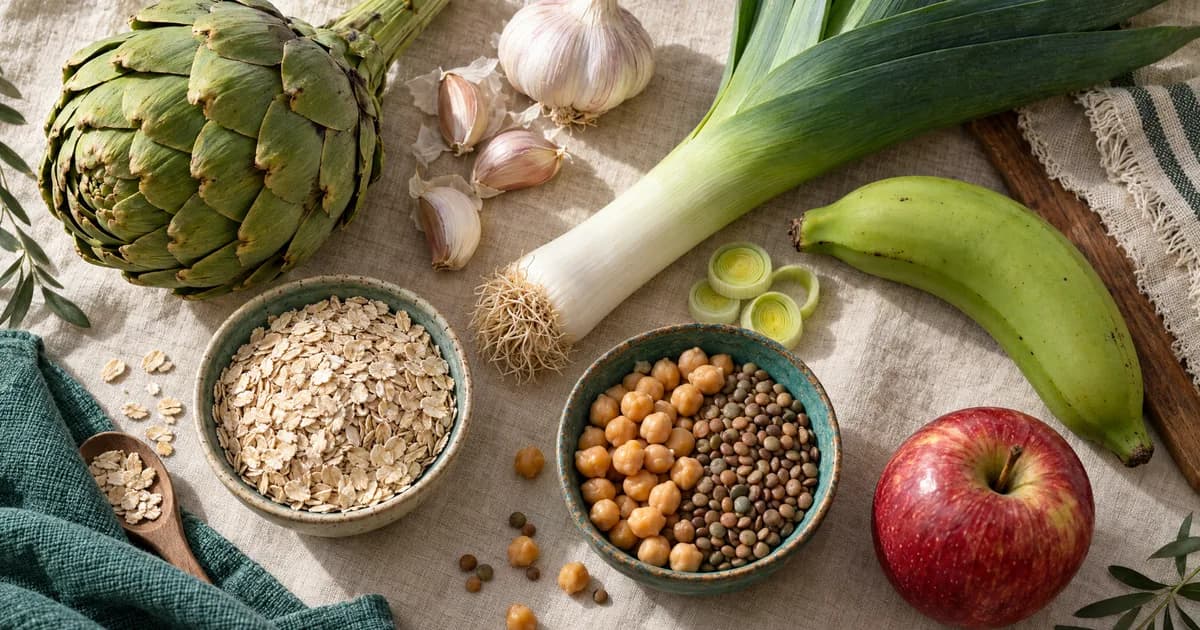
Inulin and fructooligosaccharides (FOS): the most studied prebiotics. Found in chicory, garlic, onion, leeks, asparagus, and artichokes. Specifically feed Bifidobacterium and Lactobacillus.
Galactooligosaccharides (GOS): present in human breast milk oligosaccharides — the reason breastfeeding promotes such a healthy microbiota. Also found in legumes.
Resistant starch: starch that reaches the colon undigested. Found in green banana, cooked and cooled potato, cooked and cooled rice, and legumes. Feeds butyrate-producing bacteria like Ruminococcus bromii and Faecalibacterium prausnitzii.
Beta-glucans: soluble fiber in oats and barley. Stimulates Lactobacillus and Bifidobacterium, reduces cholesterol, and has well-documented immunomodulatory effects.
Pectins: in apple skin, citrus fruits, carrots, and beets. Particularly good for Akkermansia muciniphila and Bifidobacterium.
Polyphenols (emerging prebiotics): polyphenols in cacao, extra virgin olive oil, berries, green tea, and red wine act as prebiotics — only a small fraction is absorbed in the small intestine; the rest reaches the colon where bacteria metabolize them into anti-inflammatory bioactive compounds.
The most prebiotic-rich foods
- Chicory root: the most concentrated inulin source: 36-48g per 100g. The supplement industry uses it as its primary raw material.
- Jerusalem artichoke (sunchoke): 14-19g of inulin per 100g.
- Artichoke: 3-10g of inulin per 100g, plus cynarin that stimulates bile production.
- Raw garlic: 9-16g of FOS per 100g. Cooking reduces content but doesn't eliminate benefits.
- Leeks: 3-10g of FOS per 100g. Steaming preserves prebiotics better than frying.
- Onion: 2-6g of FOS per 100g. Raw onion has higher concentration than cooked.
- Asparagus: 2-3g of FOS per 100g. Also a source of inulin and vitamin K.
- Oats: 4-5g of beta-glucans per 100g (dry weight). Also a source of resistant starch.
- Legumes (lentils, chickpeas, beans): 2-7g of fermentable fiber per 100g (cooked). Best sources of GOS and resistant starch.
- Green or refrigerated banana: 15-20g of resistant starch per 100g (green). Starch drops significantly as it ripens. Tip: refrigerating a cooked banana increases resistant starch.
- Cooked and cooled potato: 5-7g of resistant starch per 100g. Cooling cooked potato for 12-24 hours retrogrades the starch, increasing type-3 resistant starch.
- Apple with skin: 0.5-1g of pectin per 100g, plus quercetin (prebiotic polyphenol).
Prebiotics vs. probiotics: what's the difference?
| Feature | Prebiotics | Probiotics |
|---|---|---|
| What are they? | Fibers/compounds that feed bacteria | Live beneficial microorganisms |
| Main source | Fiber-rich plant foods | Fermented foods, supplements |
| Effect | Nourish existing microbiota | Add new bacteria |
| Heat stability | Heat-resistant | Heat-sensitive (most) |
| Permanent? | Yes (while consumed) | No (transient, 2-4 weeks) |
Synbiotics: the best of both worlds
A synbiotic combines probiotics and prebiotics in the same product. The idea is that the prebiotic helps the probiotic survive and establish itself better. Synbiotics are especially useful after antibiotic treatment, when the microbiota needs both new bacteria (probiotics) and the substrate for them to grow (prebiotics).
How much prebiotic fiber do you need daily?
EFSA (European Food Safety Authority) recommends 25 grams of total fiber per day. The Spanish average is 17-18g — well below the target.
For prebiotics to have a real effect on the microbiota, you need at least 5-8 grams of fermentable fiber per day (FOS + GOS + resistant starch). This equals approximately: 1 serving of legumes + 2 servings of vegetables + 1 piece of fruit with skin + 1 portion of oats.
Personalize your prebiotics with your microbiota analysis
Not all microbiota respond the same to the same prebiotics. Some people benefit enormously from FOS; others ferment them very actively and produce excess gas. The VitalOme Test identifies exactly which bacteria you have and which are scarce, allowing you to precisely choose which prebiotic fiber will benefit you most.
Order my VitalOme Test — €249Want to know the state of your gut microbiome?
Analyse your gut microbiome at home with VitalOme
Over 5,000 bacterial species analysed. Results in the app in 2 weeks. Free shipping in Spain.
Order my VitalOme kit — €249